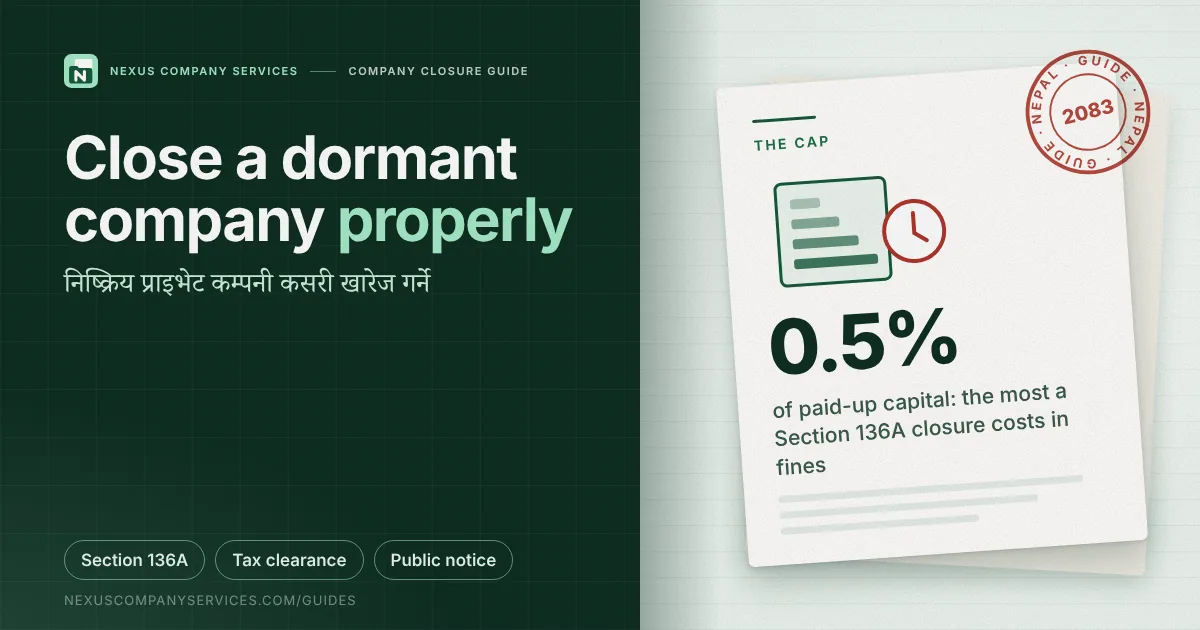
A dormant private company in Nepal is closed in one of three ways. The Section 136A special closure is for companies that were not operating, or were behind with returns or fines, on 13 January 2025; it costs the lower of the outstanding fines or 0.5% of paid-up capital, and it has no closing date. A company whose business never started can apply under Section 136. A solvent company can go into voluntary liquidation.
Why not just leave it
The fines keep growing every year a return is late. After three consecutive years of unfiled returns OCR can strike the company off, but the unpaid amounts stay with the shareholders, directors or officers who caused the default (Section 136), and a director of such a company is barred from new directorships (Section 89).
The routes, side by side
| Route | Who can use it | What OCR charges | Time |
|---|---|---|---|
| Special closure, Section 136A | Companies not operating, or with unfiled returns or unpaid fines, on 13 January 2025 | The lower of the Section 81 fines or 0.5% of paid-up capital | 30-day public notice, then OCR's decision |
| Promoters' application, Section 136 | Companies whose business never started, with the reason | Rs 1,000 up to Rs 10 lakh paid-up; Rs 5,000 above | OCR notice, 2 months for a reply, then cancellation |
| Voluntary liquidation | Solvent companies that can pay every debt within a year | Liquidator and auditor costs | Months |
| Struck off by OCR | Not a choice: three years of unfiled returns, or no business | Fines remain due | At OCR's notice |
A company registered after 13 January 2025 that never traded usually applies under Section 136 rather than Section 136A. We check which route fits before you pay anything.
Section 136A special closure: the steps
- Update the company's basic details in CAMIS and confirm the paid-up capital.
- Prepare a Section 80 return for each year outstanding.
- Pass the general meeting decision to close, or a decision of those present if the meeting has no quorum.
- Get the auditor's report on the closure and the company's liabilities.
- Get tax clearance from the Inland Revenue Department, or an IRD letter if the company has no PAN.
- The promoters sign a declaration of liabilities.
- Every promoter verifies identity, at OCR, before the chief or deputy of their local level, or at a Nepali embassy abroad.
- OCR publishes a 30-day notice in a national daily. If nobody objects, it decides online.
What stays with you after closing
The company's assets and liabilities pass to the shareholders in proportion, and anything left unpaid falls on the shareholders, directors or officers who caused the default (Section 136). A shareholder or creditor can ask the court to restore the company within 5 years (Section 137), and a restored company pays its fines first.
Is there a fine waiver?
The Finance Act 2083 waiver window closed on Asoj 31, 2083 (17 October 2026). The Section 136A cap of 0.5% of paid-up capital still applies to companies that qualify.
Questions people ask
Is there a deadline for the Section 136A closure?
No. The 2081 amendment removed the old time limit. Section 136A covers companies that were not operating, or were behind with returns or fines, on 13 January 2025.
How much does closing cost?
Under Section 136A the company pays the lower of its outstanding Section 81 fines or 0.5% of its paid-up capital, plus the cost of the missing returns, audit and tax clearance. OCR may also charge its application fee; we confirm the total before filing. Our own fee is on the company closure page.
Do we need tax clearance?
Yes for a Section 136A closure: a tax clearance from the Inland Revenue Department, or an IRD letter if the company never had a PAN.
Does anyone have to go to OCR?
Every promoter verifies identity for a Section 136A closure, at OCR, before the chief or deputy of their local level, or at a Nepali embassy abroad.
How long does it take?
At least the 30-day public notice, plus the time to prepare missing returns and tax clearance. OCR has said it aims to decide online closures within about 5 working days once the file is complete.
Can a closed company come back?
Yes. A shareholder or creditor can ask the court to restore it within 5 years (Section 137). It is restored only after its fines are paid.
Sources
Want it done for you?
Company closure, at a fixed fee
We check which route fits, work out what you will pay, prepare every paper and see it through. Our fee: From Rs 20,000 + VAT. 4 to 8 weeks.
- Fixed fee, quoted in writing before we start
- Documents in the official OCR formats
- Updates on WhatsApp at every stage
General information, not legal advice. Rules change; we check the current position for your case before filing. Legal documents are drafted under the supervision of our retained, licensed advocate.
 Company update in Nepal: how to clear missed AGMs and OCR fines
 How to check a company's OCR record and overdue filings in Nepal
 Company registration in Nepal: steps, documents and cost